电力需要你去工程化设计,而非仅仅放置。
大多数能源模组直接给你一个能产生能量的方块。Realistic Generators 给你的是一套流程——燃料 → 热量 → 蒸汽 → 旋转 → 电能——每个阶段都是真实的、可建造的多方块结构,其行为完全模拟它所代表的机器。建造得当,它会平稳运转;建造错误,它会告诉你原因。

一套完整的蒸汽发电厂是你自己组装的链条:
- 点燃锅炉将水转化为高压蒸汽。
- 将蒸汽通过涡轮机管道输送——你需要分阶段建造的转子(高压段 HP → 中压段 IP → 低压段 LP)。
- 输出 Forge Energy (FE) 供你的基地其余部分使用。
- 将废蒸汽冷凝回水并作为闭环重新运行。

这些不是装饰品——每个阀门都会影响你的输出功率,或者决定机器能否熬过夜晚:
- 压力是真实的。 如果锅炉火力过猛且蒸汽无处排放,它会发生破裂。安装安全阀,或者密切关注仪表盘。在热态下干烧会导致热冲击炸裂外壳。
- 热量具有质量。 机器会升温也会降温——没有即开即关的效果。冷启动缓慢且动力不足;热态运行的工厂效率更高。涡轮机会依靠自身的惯性自行加速和减速。
- 卡诺效率。 更大的温差可以提取更多的功(η = 1 − T_cold/T_hot)。过热提高了热侧温度;冷凝器降低了冷侧温度。保持高温,冷凝低温。
- 组装顺序至关重要。 转子必须按 HP → IP → LP 的顺序运行。如果顺序错误、留下间隙或让某个阶段孤立无援,涡轮机将产生零功率——并且仪表盘会明确指出哪个阶段出了问题。
- 尺寸需匹配。 每个多方块结构都支持可变尺寸。锅炉太小会导致涡轮机缺料;太大则会造成压力积压;电池组太小会导致过载熔化。一个连贯的链条就是一个建造谜题。
每个多方块结构都有一个带有实时仪表盘的控制台——显示温度、压力、负载、输出、效率分解,以及当出现异常时提供自然语言诊断。内置的 Patchouli 指南书会在游戏内教授整个流程。

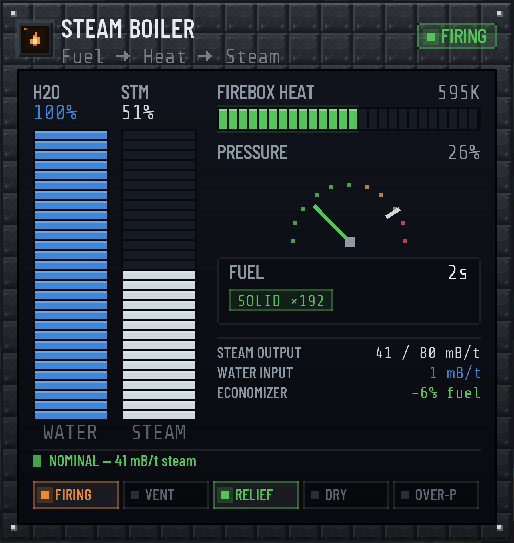
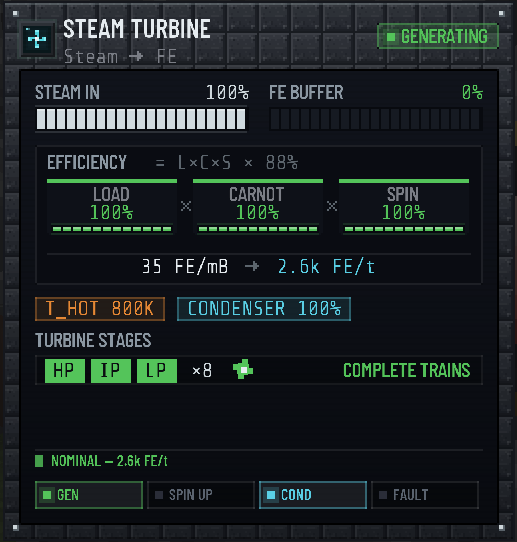
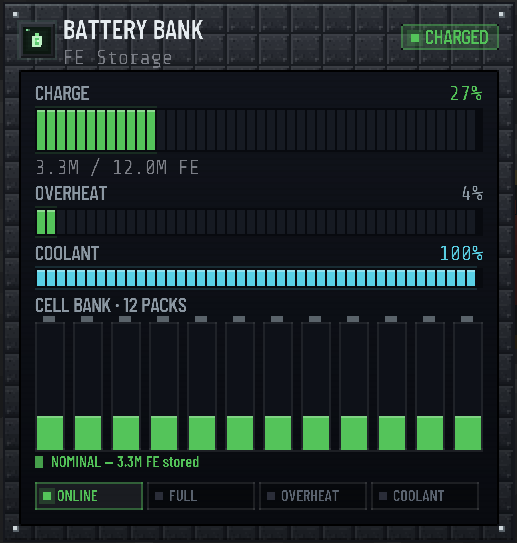
每个控制台都会打开一个专为任务设计的完整读数界面——而不是方块上的单一数字。条形图、仪表、阶段地图以及底部的一行结论,让你一目了然地知道发生了什么以及如何修复。
 |
 |
 |
| Steam Boiler — 燃烧室热量、实时压力表、燃料燃烧率和省煤器。达到极限时,安全阀会保护外壳。 |
Steam Turbine — 效率读数为 负载 × 卡诺效率 × 转速,并显示实时的 HP / IP / LP 阶段组装情况。 |
Battery Bank — 充电水平、过热和冷却剂追踪,以及电池组中每个单元的健康状况。 |

这里没有任何围墙花园。互操作性基于共享标准,因此它可以无缝融入大型整合包——已针对 All The Mods 10 构建和测试——不会产生冲突:
- Forge Energy (FE/RF) 输出——任何模组的电缆和机器都可以直接从发电机获取能量。
- 标准的
c: 标签用于燃料和材料——来自 任何 模组的煤炭、柴油、铀、粉末和锭都能直接使用。
- 流体处理能力支持进水出汽——接受来自任何来源的水。
- 无硬性依赖。 它进行协作,而不是要求。

完整的蒸汽链条:多方块锅炉、分段式涡轮机、储能装置、冷凝器、控制台仪表盘以及游戏内指南书。支持可变尺寸的多方块结构——扩大规模以获得更高的吞吐量。

核能。 具有相同真实感契约的反应堆——无法跳过的冷却剂、可引发的熔毁、必须处理的乏燃料。相同的互操作性,相同的 c: 燃料标签,相同的涡轮机。

目前该模组完全静音——没有锅炉的轰鸣声,没有涡轮机的尖啸声,也没有安全阀的嘶嘶声。这些机器渴望拥有声音。如果你从事音效设计并希望帮助让这些工厂栩栩如生,我非常欢迎——请在 Discord 上联系 benware_。

- Minecraft 1.21.1
- NeoForge 21.1.x
- 无需其他模组——但强烈建议使用流体与物品管道模组(例如 Mekanism, Pipez, XNet)以在水、蒸汽和燃料之间移动。

这是首个公开版本。机器已经可用;我最希望获得反馈的是平衡性(燃烧率、熔毁阈值、效率曲线)。在你的整合包中试用后,请发表评论告诉我感受。

MIT — 免费使用、修改,并可捆绑在任何整合包中。
Power you have to engineer, not just place.
Most power mods hand you a block that makes energy. Realistic Generators hands you a process — fuel → heat → steam → rotation → electricity — and every stage is a real, buildable multiblock that behaves like the machine it models. Build it well and it hums. Build it wrong and it tells you why.
A complete steam plant is a chain you assemble yourself:
- Fire a boiler to turn water into high-pressure steam.
- Pipe the steam through a turbine — a rotor you build stage by stage (HP → IP → LP).
- Draw off Forge Energy for the rest of your base.
- Condense the spent steam back to water and run it as a closed loop.
These aren't decorations — every lever changes your output, or whether the machine survives the night:
- Pressure is real. Over-fire a boiler with nowhere for the steam to go and it ruptures. Fit a relief valve, or watch your gauges. Run it dry while hot and the thermal shock bursts the shell.
- Heat has mass. Machines warm up and cool down — no instant on/off. Cold starts are slow and weak; a hot plant is efficient. Turbines spin up and coast down on their own inertia.
- Carnot efficiency. Bigger temperature gradients extract more work (η = 1 − T_cold/T_hot). Superheat raises the hot side; a condenser pulls the cold side down. Run hot, condense cold.
- Assembly order matters. A rotor runs HP → IP → LP in order. Get the order wrong, leave a gap, or orphan a stage and the turbine makes zero power — and the dashboard says exactly which stage is stray.
- Sized to match. Every multiblock is variable-size. A boiler too small starves the turbine; too big backs up pressure; a battery too small overloads and melts. A coherent chain is a build puzzle.
Every multiblock has a controller with a live dashboard — temperature, pressure, load, output, efficiency breakdown, and a plain-language diagnosis the moment something's off. A built-in Patchouli guidebook teaches the whole chain in-game.
Every controller opens a full readout built for the job — not a single number on a block. Bars, gauges, stage maps and a one-line verdict at the bottom tell you what's happening and what to fix, at a glance.
|
|
|
| Steam Boiler — firebox heat, live pressure gauge, fuel burn and economizer. Hit the limit and the relief valve saves the shell. |
Steam Turbine — efficiency reads as Load × Carnot × Spin, with live HP / IP / LP stage assembly. |
Battery Bank — charge level, overheat and coolant tracking, plus per-pack cell health across the bank. |
Nothing here is a walled garden. Interop is through shared standards, so it slots into big packs — built and tested against All The Mods 10 — without conflict:
- Forge Energy (FE/RF) out — any mod's cables and machines pull straight from a generator.
- Conventional
c: tags for fuel and materials — coal, diesel, uranium, dusts and ingots from any mod just work.
- Fluid capability for water in / steam out — accepts water from any source.
- No hard dependencies. It cooperates; it doesn't demand.
The full steam chain: multiblock boiler, staged turbine, energy storage, condenser, controller dashboards, and the in-game guidebook. Variable-size multiblocks — scale them up for more throughput.
Nuclear. Reactors with the same realism contract — coolant you can't skip, meltdowns you can earn, spent fuel you have to store. Same interop, same c: fuel tags, same turbine.
Right now the mod ships completely silent — no boiler roar, no turbine whine, no relief-valve hiss. The machines are begging for a voice. If you do sound design and want to help bring these plants to life, I'd love it — reach me on Discord at benware_.
- Minecraft 1.21.1
- NeoForge 21.1.x
- No other mods required — but a fluid & item piping mod (e.g. Mekanism, Pipez, XNet) is strongly recommended for moving water, steam, and fuel between machines.
This is the first public build. The machines work; the balance (burn rates, melt thresholds, efficiency curves) is what I most want feedback on. Open a comment with how it feels in your pack.
MIT — free to use, modify, and bundle in any modpack.


 模组

 模组
 模组

 模组

 模组

 模组
评论 0
登录后参与评分
还没有评论,来抢沙发吧